

Not too long ago, Sir Alan Tuckett warned that England was “overwhelmingly obsessed with initial education”: a clockwork model that begins with early years and ends with labour-market entry.
At first glance, the Lifelong Learning Entitlement (the LLE) looks like a serious attempt to break that model – unless, that is, one considers that ‘lifelong learning’ has never been a settled concept. Its definitions encompass economic purposes, certainly, but also personal development, democratic participation, social connection and learning valued for its own sake.
The LLE adopts a narrower interpretation. It connects learning to employment, retraining, skills needs and future economic return. In that sense, it might more honestly be called a Worklong Learning Entitlement. That is not to diminish the importance of learning for work in an ageing economy, but worklong and lifelong are not synonymous. That distinction has consequences, especially for older workers, and is precisely why the policy deserves scrutiny.
Awareness itself is already a problem. An omnibus survey found that only 12 per cent of adults had heard of the LLE, with a steep decline among those aged 45 and over (Stephenson, 2026). Information campaigns may improve that figure. But if the economic interpretation of lifelong learning is repeatedly communicated, some adults may reasonably conclude that the offer is intended for a certain worker at a particular career stage. The challenge is therefore not only telling people that the LLE exists but ensuring they can recognise themselves as legitimate learners within it.
From January 2027, eligible learners will be able to use LLE funding for approved modules as well as full courses. Modularity is presented as flexibility: learn when you need to, build credit over time and retrain as needs change.
But flexibility for whom?
At the British Society of Gerontology’s 55th Annual Conference, I argued as an educational gerontologist, with just over a decade of experience in the development and evaluation of further education (FE) programmes, that we cannot design effective lifelong learning policy without fully understanding the nuances of learning across the life course. My own research into the LLE’s policy texts found that its language “imagines” an adult learner who is employable, self-managing and able to navigate learning as an investment.
Modularity may not improve access for all eligible learners.
A prospective learner still needs at least a rudimentary understanding of credits and residual entitlement, financing and digital accounts, as well as the ability to accommodate interruptions and sustain a learning pathway over time (see Figure 1).
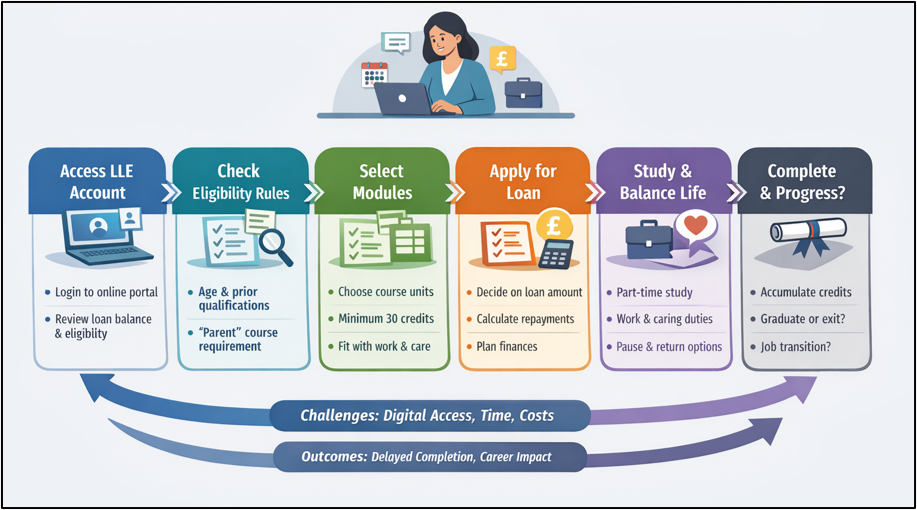
For some, such autonomy will be liberating. For others, it may create further barriers to participation. For example, less affluent learners could take longer to complete qualifications due to inadequate maintenance support or personal circumstances (Stephenson and Hulbert, 2024).
The government’s own research has identified situational, dispositional, and institutional barriers to older learner participation (DfE, 2018; DfE, 2023a), which are then partially acknowledged in the DfE’s equality analysis (2023b). None of these reports consider how maintenance support, caring responsibilities, health-related breaks, or debt aversion impact mid-life learners in practice.
Chronological age is also a poor proxy for a learner’s ability or motivation to learn. Older learners are profoundly heterogeneous. Yet the assumption of a “frictionless learner” appears built into policy design: confident, informed, digitally competent, able to tolerate debt and free enough from competing responsibilities to assemble their own learning pathways. Closing the gap between acknowledging heterogeneity and designing policy for it, requires evaluation at the level of enactment rather than reliance on projected outcomes (Saunders, 2015).
There is another reason these hidden assumptions matter in FE. The LLE is frequently discussed from a higher education (HE) perspective, despite the fact it will be enacted substantially through FE providers. Colleges have long acted as a vital safety net for learners who became disengaged or felt “written off” during compulsory schooling. This is arguably the context where the distance between the reform’s ideal learner and learners’ actual lives will reveal itself: employment gaps, caring duties, financial constraint and changing health circumstances affect the decision to commit to formal learning.
Real lives experience unpredictable friction.
In more established lifelong learning systems, movement in and out of education is ordinary. Instead, the familiar framing in the LLE of the older “returner” to education subtly reinforces the very assumptions Tuckett criticised: education belongs at the beginning of life, and anyone studying later is exceptional.
Meanwhile, despite this lack of a sophisticated conception of lifelong and life-wide learning, England is extending working life through the rising state pension age. The LLE’s age-60 tuition-loan boundary, seven years before state pension age, highlights that contradiction.
And while policy attention to the unprecedented numbers of young people not in education, employment or training is critical, population ageing is not a temporary policy challenge. The adage that ‘children are our future’ is no longer a sufficient narrative. Longer lives and extended working careers mean growing numbers of older people will remain in employment through choice or necessity, requiring continuous opportunities to learn, retrain, and adapt.
The LLE could well become an important step towards rebuilding access to higher levels of adult learning. Avoiding another policy blind spot, however, requires equitable access to education throughout increasingly longer working lives.
Approved providers therefore have an opportunity as implementation begins. Human-led guidance, age-inclusive recruitment, recognition of interrupted learning experiences and pathways that do not presume linear progression can make modularity work for today’s working adult learner.
References
Department for Education (2018) Barriers to learning: qualitative report. London: Department for Education.
Department for Education (2023a) Lifelong Loan Entitlement: impact assessment.
Department for Education (2023b) Lifelong Loan Entitlement: equality analysis.
Greatorex, J., Bell, T., Bertram, C. and Davies, A. (2024) Evaluation of the Higher Education Short Course Trial. Slough: Department for Education (DfE).
Saunders, R. P. (2015) Implementation Monitoring and Process Evaluation. Thousand Oaks, CA: SAGE Publications, Inc.
Stephenson, R. (2026) Higher Education Policy Institute (HEPI). Weekend reading: one year until the Lifelong Learning Entitlement kicks in, yet only 12% of adults know it is coming.
Stephenson, R. and Hulbert, N. (2024) Aligning the Lifelong Learning Entitlement and the Growth and Skills Levy: how these policies could work together under a new Government. HEPI Policy Note 59. Oxford: Higher Education Policy Institute.
Leave a Reply