

Longer working lives are often presented as an opportunity for purpose, flexibility and reinvention. For a growing number of older adults, however, continuing to work is also an economic necessity. What happens when the people who most need to adapt for longer working lives have the least capacity to pay for the learning required to do so?
The language of working in later life has become increasingly optimistic. We hear about phased retirement, portfolio careers, flexible working, “unretirement” and using the experience accumulated over several decades to embark on something new. There are sound reasons for this. Many people want to continue working beyond traditional retirement ages, whether for purpose, social connection, intellectual stimulation, income or because stopping work at an arbitrary chronological milestone simply no longer makes sense to them.
But there is another version of the longer working life that receives rather less attention, especially within some of the corporate discourse around age-inclusive recruitment. It is the person who continues working because retirement is financially out of reach. That distinction is increasingly pertinent as debates about pension adequacy, State Pension Age (SPA) and lifelong learning gain momentum.
Working longer: choice, necessity or both?
Recent figures demonstrate just how heterogeneous later life has become. The Centre for Ageing Better (2025) reports that around 17% of pensioners in the UK are living in relative poverty, rising to 20% in Yorkshire and the Humber. Among working-age adults aged 60 and over, the relative poverty rate is higher still at 23%.
Housing makes an enormous difference and reaching SPA does not necessarily correlate with financial independence. There are now hundreds of thousands of private renters aged over 65, and private renters in this age group spend more than a third of their income on rent. Among older private renters in England, 15% have less than £100 a month remaining after housing costs, while 29% have less than £200 (Centre for Ageing Better, 2025). One in eight people above SPA has no income beyond the State Pension and benefits, rising to one in five among single pensioners (Centre for Ageing Better, 2025).
Similarly, employment status in later life tells us surprisingly little about somebody’s financial security. There are now around 1.7 million workers aged 65 and over, accounting for approximately one in every 25 UK workers. Collectively, people working beyond SPA are estimated to contribute more than £60 billion annually to UK economic output, or around 2% of GDP (Centre for Ageing Better, 2026a).
For many, this is welcome. Around two-thirds of people working beyond SPA cite enjoyment, health, social purpose or other non-financial motivations. Alongside this, 14% report working because they cannot afford to retire and 21% because they want to improve their financial position (Centre for Ageing Better, 2026a). The same individual may, of course, experience both. But these nuances are rarely conveyed by mainstream narratives around retirement as a lifestyle opportunity.
The privilege of being able to retire
This point is often overlooked when considering the growing infrastructure around later-life careers. Research published through consultancy 55/Redefined (2022) found that 74% of respondents who would like to retire early felt unable to do so for financial reasons, while 46% expected cost-of-living pressures to make them work longer. Thirty per cent reported insufficient income for basic living costs. Even among people wanting to reduce their working hours, 41% said they could not afford to do so.
More recent research presents purpose and flexibility as increasingly important elements of later-life work, but financial insecurity remains clearly visible: only 11% of surveyed adults aged 50–70 reported feeling very confident about funding their retirement, while 45% worried about outliving their savings (55/Redefined and Just Group, 2025). This does not undermine the positive case for flexible later-life careers. It demonstrates why class, housing, health, occupational history and accumulated financial resources have to sit alongside age when thinking about them.
There is a profound difference between choosing consultancy at the age of 64 in pursuit of greater autonomy or flexibility, and needing a new occupation at 64 because decades of low-paid physical work are no longer sustainable. Both individuals might need to learn. Their capacity to invest in that learning is unlikely to be equal.
Triple-locked pensions, locked-out learners?
The debate over the State Pension triple lock makes this connection especially timely. In September 2026, the government confirmed that the existing triple lock would remain until April 2030. From then, an adjusted mechanism is intended to increase the State Pension by at least inflation or 2.5%, with additional increases where necessary to maintain its relative value against average earnings over time (DWP, 2026).
Government modelling projects that relative pensioner poverty after housing costs could fall from around 14% in 2024/25 to approximately 8% by 2049/50 under the adjusted mechanism. Importantly, the Department for Work and Pensions describes these as projections rather than predictions: they depend on assumptions about earnings, labour-market behaviour, pension participation, demographic change and the wider economy (DWP, 2026).
The Centre for Ageing Better (2026b) has responded by arguing that whatever succeeds the existing triple lock must continue to protect people most dependent on the State Pension, noting that almost 16% of pensioners are currently in relative poverty and more than a million rely on the State Pension as their only source of income beyond benefits.
These debates are conventionally treated as questions of pensions, welfare and fiscal sustainability. But they are also questions about access to further education. If people are expected, encouraged or economically compelled to remain in employment for longer, the opportunity to update their skills should not end before their working lives do.
An educational age limit in an ageing workforce
This is where England’s Lifelong Learning Entitlement (LLE) becomes particularly interesting. From January 2027, the LLE will allow eligible learners to use student finance across approved higher-level courses and modules, with new learners potentially accessing tuition-fee loans worth £39,160 at 2026/27 rates (DfE, 2026). It has been designed explicitly to support people to “train, retrain and upskill” across their working lives.
The LLE is presented as modular and therefore flexible, but such flexibility still requires learners to navigate a sequence of decisions about eligibility, finance, course choice and progression. For older workers experiencing financial insecurity, each stage may carry very different risks.
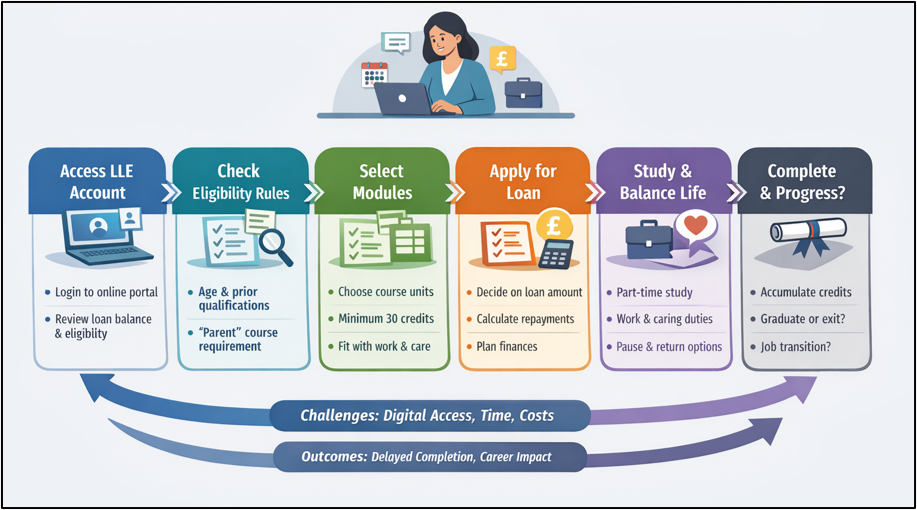
Tuition Fee Loans are available only to people who are under 60 when their course begins. The Department for Education explains that this concentrates lending on people most likely to repay, because those nearing or entering retirement are expected to repay relatively little of their borrowing. From a student-finance perspective, that rationale is understandable. From the perspective of longer working lives, it creates a stark boundary.
The SPA is already in the process of rising from 66 to 67 between 2026 and 2028. For many future learners, therefore, access to the LLE’s principal mechanism for financing tuition will end around seven years before reaching SPA, and potentially much longer before they actually leave employment.
The distributional consequences of this deserve attention. An established professional approaching 60 may have accumulated qualifications, savings, employer-funded development and enough income to purchase an LLE short course independently. A lower-paid worker of the same age may need retraining more urgently due to technological disruption or organisational restructuring. Yet they may have fewer savings, weaker pension provision and dwindling employer support with which to fund it. Chronological age tells us very little about which of them needs educational investment the most.
Learning as a safety net for longer lives
Population ageing makes this more than a question of whether adults over 60 should be able to study. Learning increasingly forms part of the very infrastructure required to sustain longer working lives, alongside its wider life and cognitive benefits. Changing occupations in desk-based work may demand new digital and artificial intelligence skills, while physically demanding roles may become increasingly difficult to sustain for older workers experiencing ill health, making retraining all the more important. Equally, caring responsibilities or redundancy may prompt a return to education after interruption, while accumulated experience can open routes into entirely different sectors.
For many, learning will also remain worthwhile simply because education continues to have life-wide value across the life course. The danger is that longer working life develops along the same unequal lines as retirement itself: those with greater accumulated resources gain the widest range of choices, while those with the least security are asked to adapt for longer with the fewest resources available to do so.
The distinction between choosing to work longer and needing to work longer therefore matters enormously. And so does the distinction between having access to learning in principle and being able to afford it in practice. As England simultaneously redesigns pension protection, increases SPA and launches a new system carrying the rather ambitious — dare I say, ambiguous — title of a “Lifelong Learning Entitlement”, these policy areas cannot remain conceptually separate. If working lives are becoming longer, our understanding of who requires education — and when — has to lengthen in parallel.
References
55/Redefined and Just Group (2025) ‘Purpose, Pay & Possibilities: Redefining retirement – Flexible working & the journey from pay to purpose’. 55/Redefined, 18 November 2025.
Centre for Ageing Better (2025) Financial Security: The State of Ageing 2025. London: Centre for Ageing Better.
Centre for Ageing Better (2026a) ‘Economic output of post State Pension Age workforce dwarfs costs of Triple Lock’. Centre for Ageing Better, 11 February 2026.
Centre for Ageing Better (2026b) ‘Triple lock replacement must protect pensioners from poverty’. Centre for Ageing Better, 29 September 2026.
Department for Education (2026) Lifelong Learning Entitlement: what it is and how it will work. Updated 24 September 2026. London: Department for Education.
Department for Work and Pensions (2026) State Pension uprating analysis 2026. London: Department for Work and Pensions.
Workingwise/55/Redefined (2022) ‘Workingwise 2022 Survey Results’. 55/Redefined.
Leave a Reply