
One of the best parts of my role on the editorial team for Leadership Connected magazine is getting to sit down with people who are genuinely rethinking how education and leadership works in practice. A little while back, I had exactly that kind of conversation with Mark Pritchard, Director of Education at Pioneer Educational Trust, and I came away with far more than I expected.
We talked about everything from teaching in Japanese classrooms to leading four schools in Berkshire, but what stuck with me was his core conviction: that leadership potential isn’t reserved for the people at the top. It’s already there, in everyone, waiting to be unlocked.
The piece below first appeared in Leadership Connected magazine. I’m sharing it here because it deserves a wider audience than that issue probably reached — and because what Mark had to say is well worth a read. Here’s how the conversation went.
Mark, a UCL IOE pre-doctoral research fellow and alumnus, radiates enthusiasm when discussing educational leadership. As Director of Education at Pioneer Educational Trust, his dynamic approach draws from a rich tapestry of experiences – from teaching in Japanese classrooms to leading multiple UK schools as an executive head.
Currently overseeing four schools in Berkshire, his infectious passion for developing others shapes a transformative vision that challenges traditional hierarchical models in education. His compelling presence and thoughtful articulation of leadership philosophy reflect someone who has not just studied leadership but lived it through various cultural and organisational contexts.
Mark’s belief that leadership potential exists inherently in all educational stakeholders isn’t just theoretical – it’s evidenced in his own journey from international teacher to trust director, through roles including headship at Upton Court Grammar School and leadership positions within ARK schools.
The Democratisation of Leadership Development
Pioneer’s flagship initiatives exemplify distributed leadership theory’s core principle that expertise is dispersed throughout organisations rather than concentrated at the top [1]. “The work is the development, and the development is the work,” Mark asserts, pointing to programmes that deliberately bring together diverse cohorts from different schools and roles.
The trust’s ‘Working Title’ programme specifically addresses representation gaps in educational leadership through storytelling and identity development. This approach echoes Harris and DeFlaminis’ [1] findings that narrative-based leadership development particularly enables under-represented groups to recognise and actualise their leadership potential.
Vertical Development in Practice
Mark’s emphasis on vertical development reflects Heifetz et al.’s [2] distinction between technical and adaptive challenges in leadership. His focus on mindset and values rather than just technical skills demonstrates an understanding that today’s educational challenges require adaptive solutions.
The trust encourages its programmes’ participants to envisage a mountain climbing metaphor for leadership dynamics, which incorporates both ascending and descending behaviours, exemplifying what Heifetz terms “getting on the balcony” – the ability to step back and gain perspective while remaining engaged in action [2]. This framework highlights the importance of “heat experiences” – challenging situations that foster growth – while maintaining strong collaborative relationships.
Preparing for Future Educational Challenges
Pioneer’s holistic and inclusive approach to leadership education aligns with Hannon’s [3] ‘system change theory’, balancing knowledge-based learning with the development of core competencies across four key domains:
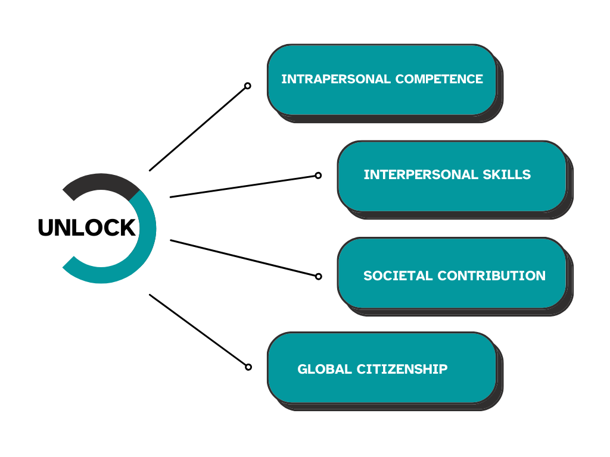
The trust operationalises this framework through strategically designed programmes. Most notably, their flagship Pioneering Leadership Programme brings together diverse cohorts across schools to develop deep relationships and adaptive mindsets. Through vertical development, participants learn to navigate complex educational challenges while building strong collaborative relationships, preparing them for an increasingly complex educational and vocational landscape.
Student Leadership: Starting Early
Pioneer extends its leadership development philosophy to students through cross-age initiatives. This approach reflects Leithwood and Sun’s [4] meta-analytic findings that early leadership experiences significantly impact long-term student success through the development of transformational leadership capabilities.
“The real voyage of discovery,” Mark reflects, quoting Proust, “is not in seeking new lands, but in having new eyes.” It is evident that this perspective guides Pioneer’s emphasis on horizon-broadening experience and self-directed learning projects, aligning with transformational leadership theory’s focus on vision and intellectual stimulation [4].
Embracing Digital Leadership in Education
As an educational leader, Mark takes a nuanced view of technological advancement in education. While championing AI’s potential to personalise learning and streamline administrative tasks, he emphasises that technology should enhance rather than replace human interaction. “AI tools can free educators to focus on what matters most – building relationships and developing young minds,” he explains. This perspective aligns with his broader vision of using innovation to support, rather than supplant, the essential human elements of education.
Looking Forward
Undeniably, Pioneer’s model is a pro-active, ‘life world’ [5] example of how distributed leadership theory can be practically implemented to create sustainable educational change [6]. This balanced approach offers a promising framework for other schools and educational organisations seeking to develop both current and future leaders while maintaining academic excellence.
As education systems worldwide grapple with rapid change, Mark’s own vision of what he terms “creative leaders” who can imagine and work toward better futures while developing others’ leadership potential offers a compelling model for educational transformation, grounded in both theoretical understanding and practical experience.
References Worth Reading
[1] A. Harris and J. DeFlaminis, “Distributed leadership in practice: Evidence, misconceptions and possibilities,” Manage. Educ., vol. 30, no. 4, pp. 141-146, 2016.
[2] R. Heifetz, A. Grashow, and M. Linsky, “Leadership in a (permanent) crisis,” Harvard Bus. Rev., vol. 87, no. 7/8, pp. 62-69, 2009.
[3] Hannon, V., & Peterson, A. (2017). Thrive: Schools reinvented for the real challenges we face. Innovation Unit Press.
[4] K. Leithwood and J. Sun, “The nature and effects of transformational school leadership: A meta-analytic review of unpublished research,” Educ. Admin. Quart., vol. 48, no. 3, pp. 387-423, 2012.
[5] T. J. Sergiovanni, “The lifeworld at the center: Values and action in educational leadership,” in Effective Educational Leadership, London: SAGE Publications, 2003, pp. 14-24.
[6] A. Harris, “Distributed leadership: Friend or foe?,” Educ. Manage. Admin. Leader., vol. 41, no. 5, pp. 545-554, 2013.
Leave a Reply